
Life is built upon a fundamental biological pulse. Our very existence depends strictly on this constant internal cadence. There is a close and vital link between human rhythm and emotions. For example, cardiac arrhythmia means a severe functional failure. The heart beats fast, slow, or irregularly without any natural control. This erratic pulse is medically known as fibrillation. Similarly, the exact same thing happens with our human brain. When cerebral oscillations appear abnormal, dangerous paroxysm arises. This sudden change in the neurological electrical pulse is highly risky. In both cases, extended irregularity usually proves fatal without immediate medical intervention.
These internal biological processes include our vital daily breathing. They are closely interrelated throughout our entire living organism. Furthermore, they constitute the absolute foundation of general homeostatic stability. They also guarantee the total efficiency of bodily physiological processes. Consequently, they allow a correct adaptation to constant daily external changes. They respond effectively to the incessant endogenous demands of the system. Our life model heavily requires this perfect synchrony to survive. If the biological compass fails, general health declines very rapidly. Therefore, maintaining a stable physiological frequency is truly paramount. Physical balance directly sustains our much-desired mental tranquility.
Regarding mental health, chronic emotional overwhelm is devastating. All my patients start therapy fleeing this painful daily reality. This severe stress blocks the ability to perceive basic homeostatic signals. People lose indispensable natural sensations, such as hunger or satiety. Furthermore, continuous exhaustion prevents processing acoustic or bodily signals properly. This worrying lack of spatial interoception generates severe psychosomatic diseases. Consequently, painful conditions like irritable bowel syndrome quickly appear. Muscular contractures and high blood pressure are also very frequent consequences. Ultimately, these physical ailments unavoidably require joint medical and therapeutic attention.
Yoruba Ancestral Wisdom to Harmonize Rhythm and Emotions
Constant dysregulation severely interrupts the natural cadence of the individual. It immediately alters the direct communication between the body and the brain. It negatively modifies the physiological stability of the sent neuronal messages. An erratic mood deeply changes how our mind interprets daily stimuli. It prioritizes and responds to internal sensations in a completely wrong way. This affects even basic organic functions like breathing or regular digestion. The negative impact between rhythm and emotions is indisputable in clinical settings. To recover comprehensive health, we must look toward ancestral knowledge. These original practices offer very profound musical therapeutic answers.
During my Afro-Cuban music studies in Cuba, I learned valuable lessons. Specifically, I delved deeply into the rich traditional Yoruba culture. There, I understood how emotional crises alter our vital aśẹ. This ancient concept beautifully represents the natural flow of internal force. Intense tensions caused by trauma, anxiety, or grief are truly disruptive. They abruptly break the Ìwàpẹ̀lẹ́, which is the sacred physical and ancestral equilibrium. As a direct consequence of this energetic rupture, disease (àìsàn) ensues. General health is completely lost when the internal compass collapses. Repairing that severe fracture requires reconnecting with our original acoustic roots.
From this extraordinary cultural wealth, I learned something highly healing. The specific metrics of each suyere (chant) have unique curative functions. Every ritual melody fulfills a particular therapeutic purpose in the community. The chant dedicated to Obatalá, for instance, is therapeutically very powerful. It successfully restores emotional stability and desired serenity in anxious clinical pictures. The sonic cadence that accompanies it provides safety and strong physical anchoring. Invoking mental clarity, freshness, and order into a highly agitated life. It greatly benefits anyone who listens, sings, or freely dances to it. Definitely, it represents a totally renewing existential energy of health.

The Case of Santiago: Healing Autism Through Music
Santiago was a seven-year-old neurodivergent boy with autism. He frequently used a very particular idiosyncratic or invented spoken language. Curiously, his vocal inflection sounded surprisingly similar to the ancient Yoruba language. The little boy was non-verbal and only used those sounds in his soliloquies. This difficult situation deeply distressed his worried parents. They rigidly tried to correct or silence him on a constant basis. Consequently, the minor arrived at the school center experiencing severe crying meltdowns. He threw himself to the floor, devastated by so much misunderstanding and external pressure. He was urgently referred by psychiatry to music therapy to balance his rhythm and emotions.
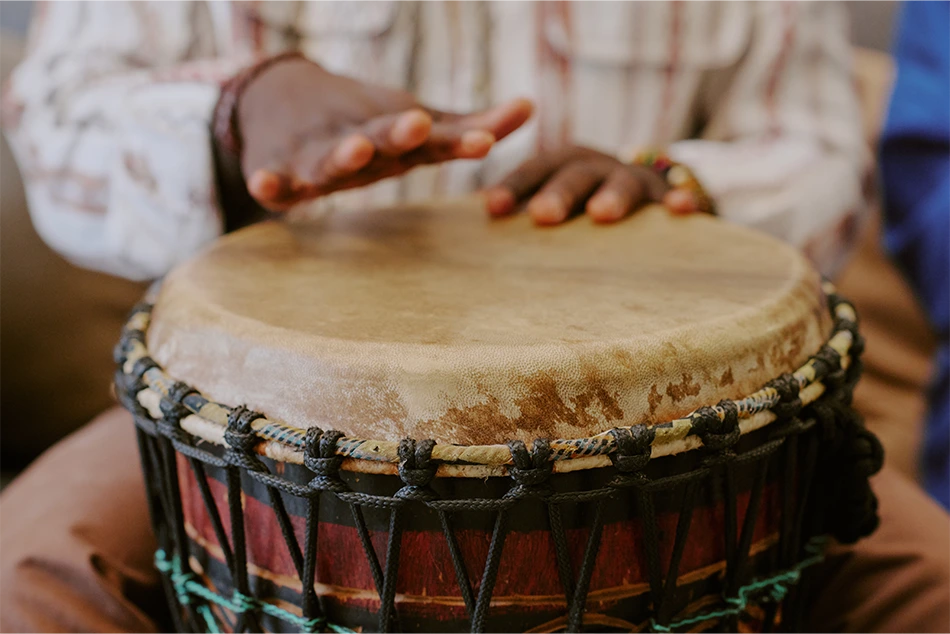
During his first session, the infant entered highly altered. He threw himself to the ground kicking, mixing shrill screams with intense crying. To prevent him from physically hurting himself, I established an initial protective silence. After a few brief seconds, I started playing a soft acoustic beat. I used the itotele rhythm on a small African drum called a dundun. I carefully avoided establishing direct eye contact to not overwhelm him psychologically. As soon as he heard the sounds, he progressively began to calm down. He stopped screaming, staying on the floor, listening very curiously. Slowly, I got up, playing while walking in circles around his body.
I used the basic steps of the traditional Obatalá dance. I hid behind an office screen, playing the drum without stopping. Intrigued, the patient approached the screen and smiled spontaneously. I came out dancing freely while playing; he laughed happily and followed me. We entered a beautiful dynamic of mutual empathy and physical synchronization. He began to ‘speak’ with his language, and I imitated him joyfully. Confidently, he approached, placing my own hands on the drum skin. I improvised a healing melody incorporating the exact words the child emitted. Finally, we successfully replaced the rigidly demanded obedience with safety, connection, and deep calm.

